
At Dr. Ashish Agarwal’s Cardiology Practice, innovation is guided by one clear priority—patient safety without compromising outcomes.
Patients with chronic kidney disease (CKD) often face higher risks during coronary angiography and angioplasty due to the use of contrast dye, which can worsen kidney function. Understanding this concern, we offer advanced Minimal-Contrast and IVUS-Guided Angioplasty, designed specifically to protect the kidneys while ensuring optimal heart care.
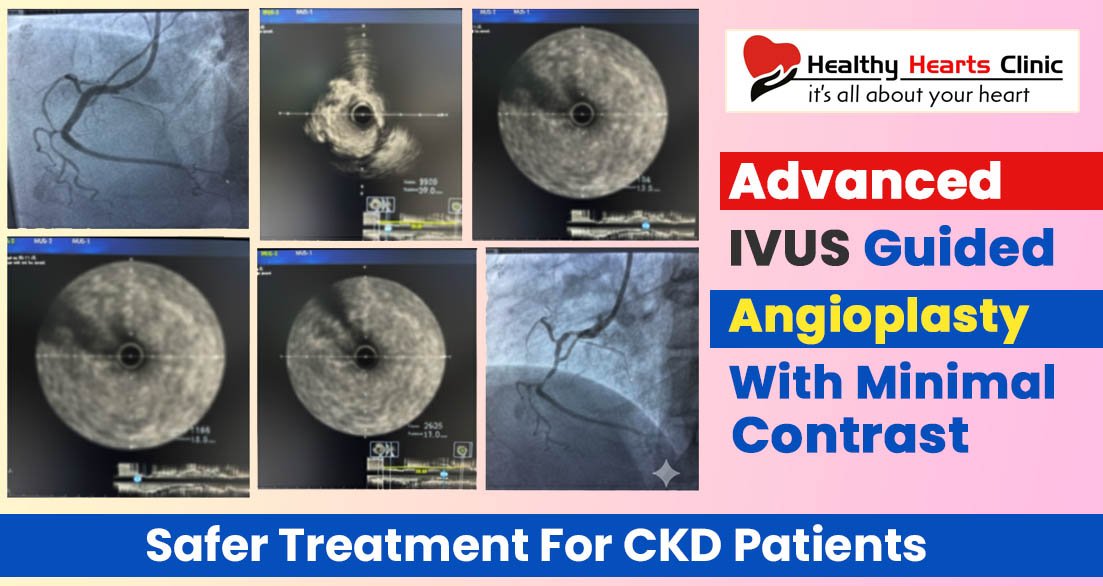
In this case, the patient’s family was understandably apprehensive as the baseline creatinine was 1.5 mg/dL, indicating reduced kidney reserve. Using new-generation imaging techniques, the procedure was performed with utmost precision and safety. The patient showed confidence in these advanced methods and consented to proceed.
Remarkably, the entire angioplasty was completed using only 5 ml of contrast, significantly reducing the risk to kidney function.
Minimal-contrast PCI (Percutaneous Coronary Intervention) is a modern coronary intervention technique where the smallest possible amount of iodinated contrast dye is used—typically ≤20 ml, and often less then 10 ml in CKD patients—without compromising procedural success or safety.
This approach relies heavily on intravascular imaging such as IVUS, allowing accurate assessment of:
Patients with moderate to severe chronic kidney disease face higher risks during conventional angioplasty due to contrast exposure. Minimal-contrast PCI is especially beneficial for such individuals because it:
Performing minimal-contrast angioplasty requires deep expertise, meticulous planning, and advanced intravascular imaging techniques. Under the leadership of Dr. Ashish Agarwal, patients benefit from:
By combining clinical expertise with cutting-edge technology, we ensure that even high-risk patients receive safe, precise, and kidney-protective cardiac care.
Schedule a consultation with our experienced cardiologist and take the first
step towards a healthier, stronger you.
Copyright © 2025 Dr. Ashish Agarwal | All Rights Reserved
 The Story Door