
Interventional cardiology often presents situations where anatomical complexity, patient instability, and time-critical decision-making converge. One such challenging scenario is the management of densely calcified coronary artery lesions, especially when conventional balloon angioplasty fails. This case exemplifies how rapid team coordination, procedural adaptability, and advanced plaque modification techniques can transform an otherwise stalled intervention into a successful outcome.
The patient presented with severe coronary artery disease involving a heavily calcified vessel, compounded by critical clinical instability. During coronary intervention, the lesion demonstrated extreme resistance, such that even the smallest available 1 mm balloon could not cross the stenotic segment.
Despite optimal guide support and wire positioning, traditional balloon-based strategies failed due to the rigidity of the calcified plaque.
Recognizing the urgency of the situation, the interventional team promptly:
In a critical moment during the procedure itself, clearance for rotational atherectomy (rota) was obtained. This swift decision-making and seamless teamwork proved pivotal, preventing procedural abandonment or adverse outcomes.
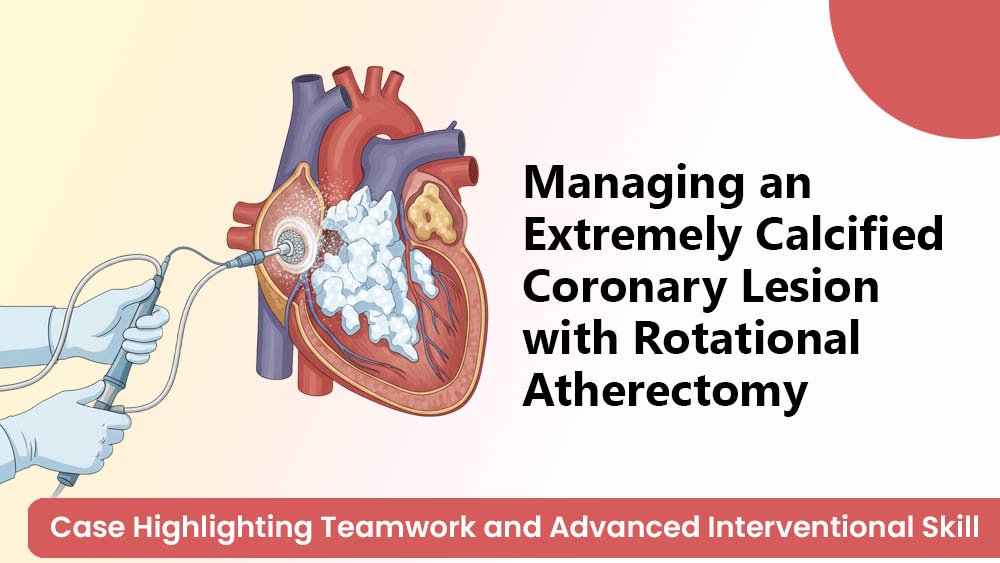
Once authorization was secured, rotational atherectomy was performed to modify the calcified lesion. A rotational burr was carefully advanced across the stenosis, effectively ablating the rigid calcific plaque that had resisted all prior attempts.
The final angiographic result was excellent, with restored flow and no residual stenosis.
Despite the initial complexity and critical patient condition, the procedure concluded successfully. The patient stabilized hemodynamically, and the vessel was fully revascularized with superb procedural results. This case stands as a testament to the importance of experience, preparedness, and collaborative teamwork in high-risk interventions.
Rotational atherectomy is an advanced plaque-modification technique used in interventional cardiology to treat severely calcified coronary lesions. It employs a diamond-coated, high-speed rotating burr that selectively ablates inelastic calcified plaque while preserving the more elastic vessel wall.
Rotablation was essential to create a channel through the calcified plaque, allowing subsequent balloon dilation and stent delivery.
Schedule a consultation with our experienced cardiologist and take the first
step towards a healthier, stronger you.
Copyright © 2025 Dr. Ashish Agarwal | All Rights Reserved
 The Story Door